Where is the network?
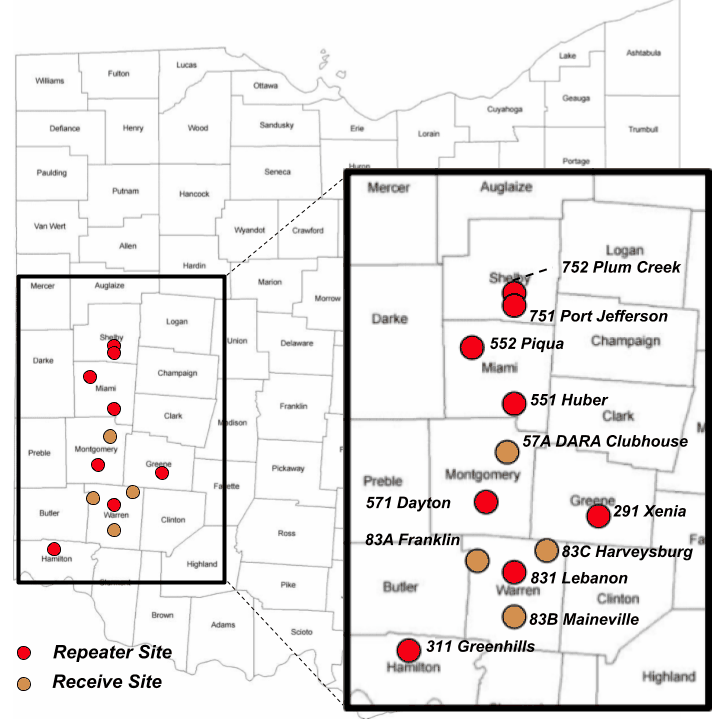
MVP25 is a group of UHF P25 repeater sites in southwest Ohio, with active sites in Greene, Miami, Montgomery, Shelby, Warren and Hamilton counties. Small test sites with very limited coverage also operate in Columbus and Shelby County as private locations for learning and troubleshooting.
The Miami Valley is the land around the Great Miami River in southwest Ohio, and includes the Little Miami, Mad and Stillwater rivers. It takes in Dayton, Springfield, Middletown, Hamilton and other communities. The name comes from the Miami people.
Why MVP25?
Many digital repeaters are tied to state and worldwide networks. Those networks create an almost non-stop run of traffic from other regions and around the globe, and the repeaters on them suffer from transmit overload and failure. They also lack the isolation that builds a community of hams you might meet in person.
MVP25 connects repeaters across southwest Ohio into one reliable, shared regional talk path. You can talk to users on any repeater from any other repeater, and each site can also be used on its own for local conversations.
How it's built
The network is built with the highest-grade (public safety) Motorola, Cisco, Ric-M and other hardware, and was developed with subject-matter experts who work professionally in networking and public safety communications design and maintenance.
- The comparator, which votes the best audio from every site, is at the DARA clubhouse.
- A secure private network sits at the root of the system. Sites have backup power and can operate independently if a link fails.
- No reflectors. Most digital linked networks connect to cloud-hosted reflectors, which work well but don't support all the features of P25 public-safety radios. On MVP25, all voice and data passes to each site over direct network connections, handled by dedicated purpose-built devices rather than software on a computer. That means fast, reliable, simultaneous delivery of voice to every site.
- RF access only. The network is reached from subscriber radios over the air. There is no public hotspot, and no access to MMDVM reflectors (worldwide, nationwide and so on). Linking hardware or software is strictly prohibited, and voice and data may not be forwarded to or from reflectors or any other external source.
Version 3: vote/scan roaming
With Version 3, every repeater scans all of the system's input channels. When you transmit on any MVP25 frequency, every repeater in range sends your audio to the comparator, which picks the best audio and sends it to all repeaters to transmit. It keeps checking, so the source may change many times during a short contact, with no action needed from you.
Radios programmed with vote scan roam on a single MV Link channel: the radio picks the strongest repeater on its own, anywhere in coverage.
Version 2 radios work with Version 3 repeaters and benefit from the voted receive audio. Version 1 radios must be reprogrammed; they contain incompatible talkgroups that cause harmful interference.
Version 3 keeps talkgroup 9371 "MV Link" and talkgroup 8900 "Simplex" on NAC $4CE, so these work with every previous version.
Since Version 2, each repeater can also be used on its own. Talkgroup 9001 "Site" on a NAC matching the repeater's number (for example $571 for 571 Dayton) stays on that repeater and is not sent over the network, so a local conversation doesn't tie up the other sites. See the history for how the system got here.
Who runs it
The MVP25 group is made up of four officers, the repeater owners and licensed amateur radio users who came together to build a professional P25 system in southwest Ohio. The system is open to registered amateur operators who are expected to follow the standards set by the group so that communication stays at the highest standard. Users who don't follow these standards will be de-listed from the system.
MVP25 is an independent group and is not part of the Dayton Amateur Radio Association. We're grateful to DARA for its support and for hosting our weekly get-togethers at the clubhouse.